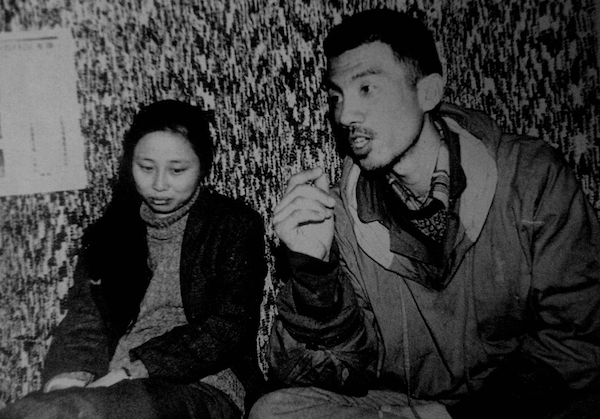

A. Li Xianting interview with Xiao Lu
Li: Let’s talk about this work from the beginning.
Xiao: Can I start from my graduation work?
Li: Is there anything earlier than that?
Xiao: Earlier…let me put it to you in this way. At the time of my graduation, after I had produced a preliminary plan for this work Dialogue, which was to be my graduation work, I am grateful even to this day to my teacher Zheng Shengtian (郑胜天), for he had just returned from the US with a whole lot of new concepts. I had at that time already worked with various materials including oil paint and xuan paper, but it had all been two-dimensional. I had no conception of making something completely three-dimensional, nor of suddenly escaping from the idea of a picture as such. From then on, my teacher Zheng Shengtian had me use photographs. He said to me: “Just you use photographs, use real materials,” which made a very big difference in guiding my work.
Li: What year was this?
Xiao: It was when I was creating my graduation work in 1988. The creative process worked like this. After I had come up with the composition and decided to use these materials, I had to present it to the Oil Painting Department and get their approval for the draft. The Oil Painting Department refused to approve it, on the grounds that they couldn’t have such a work produced in the Oil Painting Department. The work was shot dead, and there was no possibility for it to come into existence at that time. However, Professor Zheng said that the idea was excellent. Maybe he also felt that it would be very interesting if this work could be produced, but ultimately there was a compromise. I found a photograph at random and painted an oil painting based on it. This was my graduation work from the Oil Painting Department, and that was the work assessed. That’s how my graduation work came about, and that was the work that was marked.
Li: Oh.
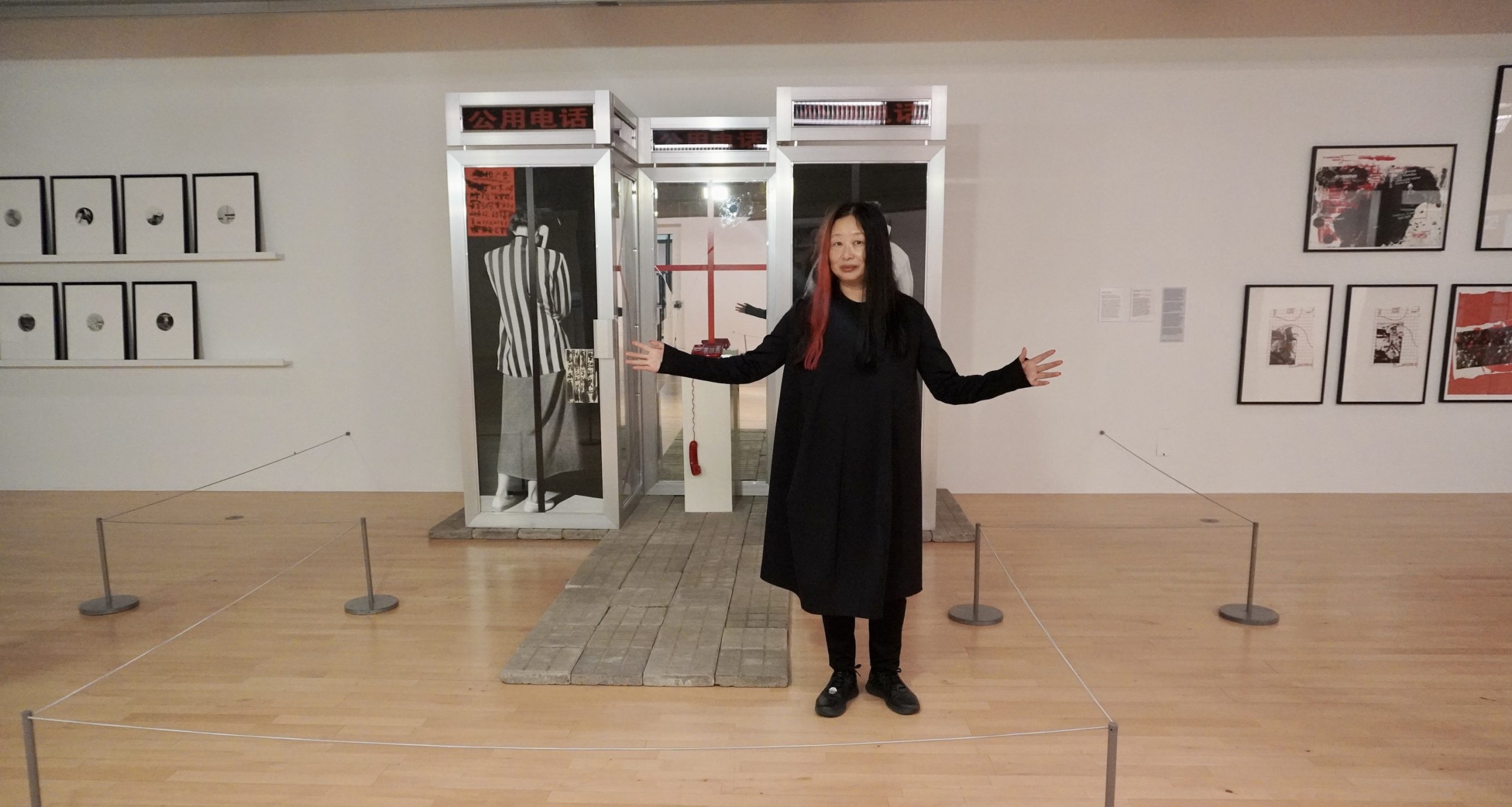
Xiao: So this graduation work back then was not straightforward at all. I am very grateful to my teachers Professors Song Jianming (宋建明) and Zheng Shengtian. Both of them did everything in their power to help me carry this project through. The Oil Painting Department had never before produced a work that wasn’t an oil painting. This was how the process was, and it was made in 1988. After I had finished this work, I asked Song Jianmin to look at it. He is currently Vice-President of the China Academy of Art. At the time, these paper strips weren’t there, and the surface of the picture was very clean. Subsequently several people said that that this surface was too clean, and that it should be broken up a little. Besides, the red colour seemed to clash with the lower part, so considered from a formal point of view, all that was added later, and there was talk about the glass. In fact, the idea of actually shooting came out of a conversation once with Song Jianmin, who wondered whether the glass shouldn’t be broken. Then the two of us spoke about using a slingshot, or an airgun or some other gun – just in the context of our discussion, but I hadn’t thought about actually doing it or not. Let me just talk about the original idea of this work. In fact, I wrote something about it. Would you like me to show it to you?
Li: Sure, in a little while.
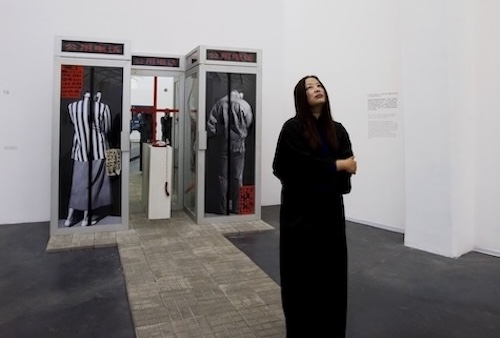
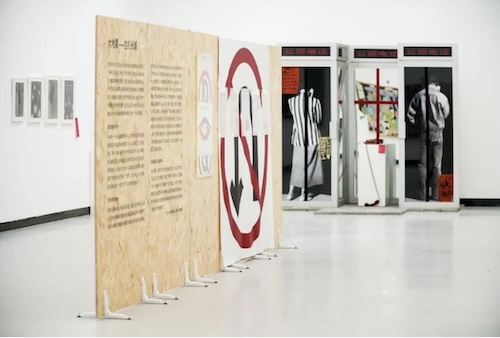
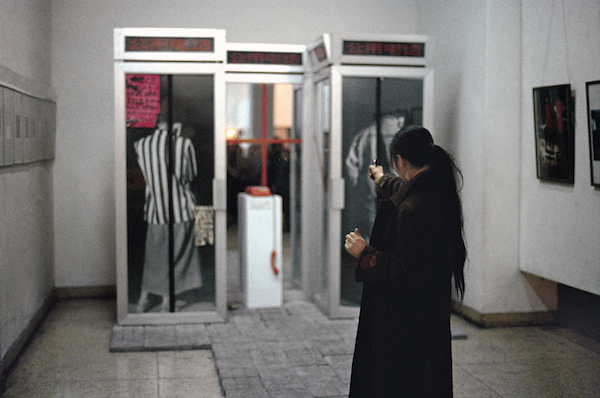
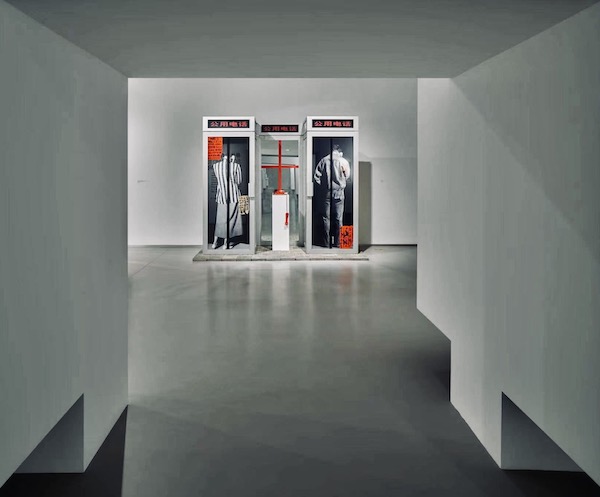
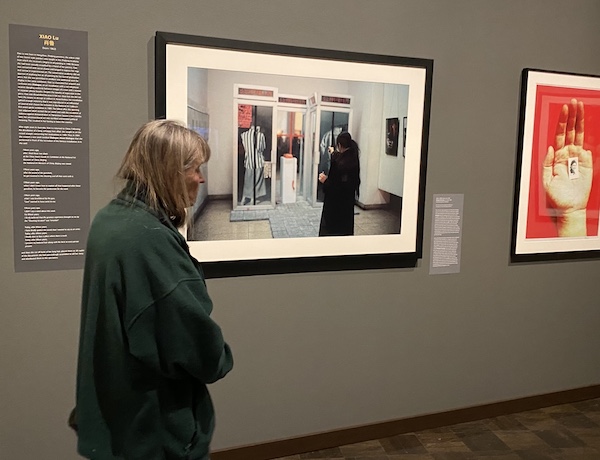
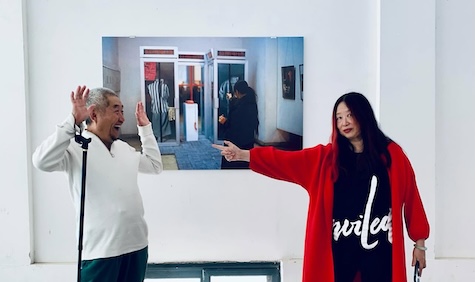
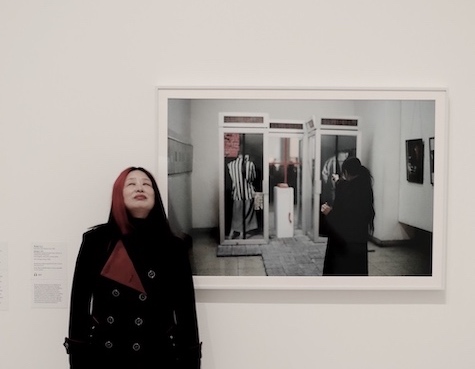
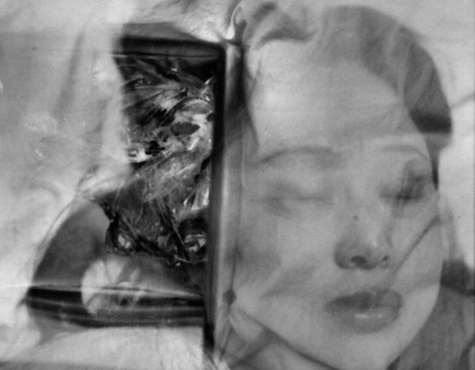
Xiao: Because at the time Professor Zheng also wanted to write something for me. Gao Minglu came over once to talk about this business, and had me write something. Afterwards I did, but I haven’t sent it yet, although I have finished it. He said that I must write about this thing in a completely truthful way, and I wrote about the process from the original idea to its full development. In fact, my original idea was for an extraordinarily personal work about emotion. Up until 1988, I was rather perplexed about emotions. Put it like this: you can see from this work that it is about a dialogue between a man and a woman. My earliest idea was about a male-female dialogue, and the telephone call was one that failed to connect. You can see those signs on the side. When you walk in and see there is a sort of resonance between the half of a man and half of a woman. The signs and the busy tone of the telephone off the hook were a very contradictory state at the time, and I was actually in this state when I completed it, a state of perplexity between men and women, I suppose, but at the time when I was making this work, my own feelings were still very intense, as the contents and form of many things were organically linked. The idea of shooting was actually discussed with a teacher in 1988, but even after we talked about it, I didn’t actually do it However later, before it was shown, I asked someone on the Hangzhou shooting team. His name was Sha Yong (沙勇). These people are all still alive, and you can go and interview them, Song Jianmin, Sha Yong, Zheng Shengtian, you can go and aske them about the facts. Sha Yong was going to lend me a gun for three hours, but something went wrong that day, for some reason I didn’t find him, nor did he find me, and after three hours, he had to return the gun to the shooting team. In other words, this plan was not executed, although it lingered in my mind. When this work of mine was selected for the China/Avant-garde Exhibition, I saw Tang Song at the Ark Café and talked about this matter. Tang Song’s real influence on this work began when I talked to him about it. He asked me whether or not I would dare to fire two shots in the Chinese National Art Museum. I said why not. I also said that I had a buddy in Beijing called Songsong (松松) and that he might have a gun. The reason I knew he had a gun was that his family and mine had been family friends from when I was a child, and he was about seven or eight years old. My maternal grandfather had been the leader of the Tianfushan uprising, and his paternal grandfather had been with the Shandong First Army from the beginning, and so my connection with him was very good. Later, when I came to the Subsidiary High School in Beijing, I taught Songsong to paint every Sunday, and later he showed me that he had a gun. Well, it should be said that the gun was something his grandmother had looted during the war.
Li: Oh, so it wasn’t his grandfather’s.
Xiao: No, it wasn’t his grandfather’s.
Li: OK, that means it was an old gun.
Xiao: It was his grandmother’s automatic. She was very fond of this grandson of hers, often let him play with it and look at it, and just as often took it back. It was an automatic pistol.
Li: What model was it?
Xiao: Even Songsong himself wasn’t sure what model it was. Because when he was a child, I would go to his family’s house every Sunday to teach him painting, he would show it to me when I went there. He was just a child, wasn’t he? He’d say: “Big Sister, look, I’ve got a gun!” So when Tang Song raised this matter with me, my first reaction was to say that once in Beijing, if my buddy could lend me a gun, I’d do the shooting. That means that when he talked about this matter at the At Café in Hangzhou, and he prompted me to fire the gun, that’s what his connection with the business was. Afterwards, once I had arrived in Beijing, I went to ask Songsong, but at the time he was still on a bus, so I rang him later, asking him: “Can you lend me that gun?” Songsong said that his grandmother happened to be in hospital, and he had the gun at his place.
Li: What’s his grandmother’s name?
Xiao: Her name…I can’t think of it off hand. I’d have to ask her. His grandfather’s name is Li Yaowen – the one who’s Political Commissar in the Navy.
Li: Is he retired now?
Xiao: He’s retired.
Li: Still with us?
Xiao: He’s still with us. So the gun was one the mother looted during the war.
Li: It wasn’t a gun you’d have now.
Xiao: I asked Songsong the same question. I asked: “Did I ring you that time or ask you in person?” Songsong said: “When you came to Beijing and went to our house, you talked to me on the bus, and your voice was so loud that I was dead scared and I said ‘Big Sister Xiao Lu, please speak softly’.” I said: “Can you do it or not?” He said: “No problem. I happen to have the gun now.” When I think back on this incident now, it must be said that there was a great deal of chance that contributed to this thing. It was not the sort of thing that Tang Song described as planned to that degree, for so far as his role in it goes, in terms of premeditation, he didn’t even know whether the gun would be provided on the following day.
Li: When he came to install the telephone booth, I asked him, and he said he would say nothing yet, and that he was still planning.
Xiao: When he came to Beijing that time, he wanted to do something with a blood donation vehicle. He knew about the business with firing the gun. It should be said that he knew about it already in Hangzhou. He had inside knowledge. Hed really did.
Li: Were you lovers at that time?
Xiao: Definitely not.
Li: Oh, so at the time you were not yet lovers.
Xiao: No. It was only when we were released from jail for firing the gun that I fell for him.
Li: Aha.
Xiao: Alright, I’ll tell you about his relationship. It wasn’t like that. I didn’t fall for him. I didn’t even know him in 1988. I only really met him when we met in the At Café a few days earlier. At the time when I was making the telephone booth, my state was…well, in fact I was very confused about life. I felt that a lot of things were not going right, and when I had fired the gun, I had this very icy-cool feeling, the feeling of having rid myself of something. I found Tang Song’s popping up very strange and felt at the time that it brought me something like an illusion, especially when we were jailed. The day before I fired the gun, I’d talked with Tang Song about this matter of to fire or not to fire the gun, because he was someone who knew about it. Songsong knew about it. At first it was only those two that knew about it, nobody else. I’d spoken to Songsong about it, but Songsong was a child, only 15 at the time, he thought I should fire the gun…
Li: He hadn’t started the Subsidiary High School at the time?
Xiao: He had just started. He said: “Fire it, Big Sister Xiao Lu! How much fun would that be?” That was his point of view, because for him it wasn’t a serious matter, nor had I explained it…. frankly, if you asked me how strong my talent for politics was, it was frankly speaking not, really not that strong, but Tang Song’s was stronger.
Li: Mm, yes, Tang Song has a talent for politics. Because later when I was in Taiwan and talked about this matter, Tang Song was constantly seeking a political zero-point [Translator’s note: 零界点, lingjiedian, ‘zero point’ probably a transcription error for phonetically similar 临界点, linjiedian, ‘critical point’, see Liao Wen’s 2012/2016 article on Tang Song’s Critical Points (唐宋的临界) and Tang Song’s own Letter to Li Xianting]. He is perhaps relatively sensitive to politics.
Xiao: He is indeed sensitive to politics, but this guy… just as you said, he reads those old books, he reads Sunzi, he is very strategic, including in this matter. To tell the truth, if it came to criminal penalties, the ones to be punished would be myself and Songsong. He’d have no problem. He has nothing to do with this at all. The reason he was arrested, thinking about it later, is this. You can see it on the video. Just before I fire the gun he said: “Shoot.” There was a plainclothes policeman nearby when I fired the shots: “Bang! Bang!”. You can see it on the video. The plainclothes policeman wanted to arrest him first. At the time the police had a most clear idea which was that this man was inciting a girl to shoot, so they arrested him. That’s how that was.”
In the end, I remember that he originally had nowhere to stay. Two days before he had stayed in a hotel, but the day before the shooting I said I that I would be staying at my maternal grandmother’s, and that he could stay there if he wanted. We went there together, but my grandmother wouldn’t let him stay. I had a boyfriend at the time, and he had a girlfriend, and there was no relationship between us at the time, as I suppose you know already. I also asked him then about the shooting matter, and he said that was my business, and that I was the boss of my own work. At that stage, to tell you the truth, the question of whether to shoot or not was still open to decision, so when Songsong rang me that day, he was still saying: “Big Sister Xiao Lu aren’t you going to shoot? Come on, do it!” I said: “You bring the gun and we’ll see.” So he did.
When Songsong then brought the gun it was already after ten o’clock. Tang Song didn’t know whether the gun had been brought or not. When he left the night before he didn’t even know whether the gun was going to be brought. I can’t remember clearly now, but I seem to have an impression that Hou Hanru (侯瀚如) said I’d spoken to him. The last time he came he also talked to me about how I’d said this and said that at the time. He remembered this very clearly. Songsong also remembers this business. He says that my face was all red and that I seemed somewhat nervous, as I was hiding this gun in my hand all along with three bullets in it, all loaded in the chamber ready to go “Bang! – Bang! – Bang!” on their way out. My impression isn’t very distinct and I’m not too clear about exactly what I said to Hou Hanru. He said I called him to the railing of the Art Museum and said: “How would it be if I were to fire a gun in a little while.” He says I said this to him. I didn’t know Gao Minglu well, and I knew you, and then Hou Hanru said: “Wait for a bit. Shoot when there are fewer people.” I don’t know now. I was perhaps somewhat nervous, so I really don’t remember what I said.
He said that’s what I said, and I said I supposed so. If I were thinking about anything before firing the gun, that’s probably what I would have been thinking. Then I also told somebody called Ju Yi (居奕), saying: “Wait a bit, you do the video’ing for me.” So Ju Yi knew. Tang Song arrived at eleven. He had no idea that I had got the gun. After he had arrived, I told him told him that I had brought the gun, and he was very excited and asked: “Have you really brought it?” I said: “I’ve got it. Songsong brought it for me.” He was more aware than I was in this respect when he asked me: “Xiao Lu, are you afraid of going to jail?” I said: “What’s so scary about that?” He then said: “Alright then, go ahead and shoot then.” Then I called Songsong over and the three of us – well, you can the three of us in that video. We’re all visible. Then he stood at my side and said: “Shoot…” and I shot. That’s how all that happened.
Li: You fired two shots.
Xiao: I fired two shots. There was one bullet left. It was quite scary with one more shot left. Songsong says he loaded three bullets…no, he loaded five bullets in all. First he fired a shot in their cellar, then he went to Houhai and fired the gun again, and then he left me with three bullets. In all there were five bullets, that’s how it was. When I returned the gun to him I had fired two shots. I gave the gun to Songsong. Tang Song was on this side of me, and the plainclothes policeman next to us first grabbed him and marched him away. When I saw him being arrested, I darted into the black box work, well I first gave Songsong the gun and then ran off, saying: “Songsong, you take the gun.” After I was in the black box, I don’t remember who I found, but I said: “Help screen me and sneak me out of here.” It seems it was the creator of the “East South West North” black box [Translator: Zhang Yongjian (张永见《黑匣子——天命指南——由痣看命》(1989)) “Black Box – Guide to Destiny – Skin-mole Fortune-telling”], but I can’t work out who it was. So three people helped me sneak out the back way, and from there I went to the Baihua Art Supplies shop, from where I watched what was happening.
Li: Afterwards you sent me a message, I don’t know who you sent, I don’t clearly remember this detail now, you sent me somebody asking me what to do, and I said you should come out, come out and explain things clearly to the police.
Xiao: Perhaps that was in the afternoon.
Li: Yes, exactly. In the afternoon.
Xiao: At what time? Four o’clock.
Li: They had already shut some of us, the Exhibition organizers, in the small conference room. The police was having a meeting with us. Oh, so were in the Baihua shop all along!
Xiao: While I was in the Baihua shop, I saw everything close up, the police cars passing, the Art Museum being closed, Tang Song being arrested, I saw all of it. In fact, at the time I felt really…
Li: …that you had stirred up big trouble.
Xiao: That I had stirred up big trouble. This buddy had been arrested, because however you put it, the people who knew about this were just the three of us: Songsong, Tangsong and myself.
Li: Songsong was alright?
Xiao: Songsong had taken the gun and left, and because he hadn’t shouted “Shoot!”, but Tang Song next to me had, so he was taken away. I don’t know if I should say this or not, but this person has already died…there was someone at the Fine Arts Academy called Maryn Varbanov.
Li: Oh, so you know about Mr Varbanov? He had a studio at the time at the Zhejiang Academy of Fine Arts. Gu Wenda, Liang Shaoji, Shi Hui were his students and were influenced by him. He has contributed to modern art in China.
Xiao: When I was creating my graduation work, Varbanov also helped me a lot. He influenced all of us, the entire wave of ’85 at the Academy, and in the creative process of this particular work he gave me some very helpful feedback, including ideas on how to manage this space, so I felt very trusting of him at the time. He was the first person I went to see about this matter, and it was at the Beijing Hotel, but I felt that he was dead against this business being any good. I explained the entire circumstances of the work to him, but he said: “I’m a foreigner here, you shouldn’t come to me” and he didn’t provide any ideas at all. At the time I felt…
Li: Well, it’s understandable. It’s wise for foreigners not to get mixed up with political events such as this.
Xiao: So then I just left the Beijing Hotel, but I’m still very grateful to him, so you don’t have to mention this matter.
Li: Un-huh.
Xiao: Then I got on a bus on the road next to the Art Museum. It was really strange. I’ve forgotten how many trips back and forth I sat on that bus, but it was until about four in the afternoon. I remember that it was about four o’clock when I gave myself up. So there were three things that happened in between. I went to the Baihua shop. I went to the Beijing Hotel. And I rode the bus route a few times, and then I decided to give myself up.
Li: At the time you sent word to me about how to proceed.
Xiao: That was after I had returned.
Li: Was that at the Baihua shop, before you had given yourself up?
Xiao: It was just before I gave myself up. I hadn’t got to the Art Museum. I was hanging around outside until around three or four o’clock and decided to turn myself in. When I was trying to turn myself in, I saw a whole lot of people, and then I managed to pass a word in. I remember that when I was turning myself in, even when I told the guard on that entrance that I was Xiao Lu and that I wished to turn myself in, he wouldn’tt let me in. Afterwards, when my message had got through – I said: “You tell them inside that I am Xiao Lu, and they will let me in.” At that moment, when I had decided in my mind to turn myself in, the whole thing became very simple, and I just decided to go in. After I had turned myself in, it was just a matter of taking me into custody, I suppose. Then we first went to some place which I have forgotten, and then to another place, I suppose the Dongcheng Precinct Detention Centre, wasn’t it?
Li: Right, the Dongcheng Precinct Detention Centre is close to what is now the Asian Games Village, which was then a construction site. I went to the Dongcheng Precinct Police Station to see you, and they told me the Detention Centre was there. I found a taxi to get there, that was myself, Liao Wen (廖雯), and there was somebody else whom I have forgotten, so a couple of people. When we got to the Detention Centre, they said: “We did have those people in custody here, but they have gone already. I even had a box of cake, haha!
Xiao: Yes, Songsong told me about this at the time. He said he had been too silly. I had given him the gun. He had taken some photographs for me with a point-and-shoot camera and gave me the camera and said he had shot a roll of film. The result was that the police had confiscated the lot and exposed the film. He said he was young, and therefor wasn’t thinking things through. I remember the interrogation very clearly. Today I think I was in a panicky state, being only 26 years old. In those days creating modern art relied on passion and impulsiveness. There are many elements in this. Besides, I felt that doing this was loads of fun. I felt passionate. There were all sorts of exciting feelings in it. Really, this thing… Anyway, there were actually many random factors that contributed to this business. If you want to talk about planning in this matter, about Tang Sing planning it, it’s just not so. If he was planning, there were a lot of things that he knew nothing about. You can’t count that as him planning.
Afterwards when we got to the jail, as I always say to Tang Song, I really felt it was really special that as I came out of this place after the interrogation, he came out of another place after his interrogation, and then we met in the middle near the entrance to the detention centre. At that moment, as we were both hand-cuffed and about to go to jail, he gave me that smile. At the time I felt that smile was very unruffled. Perhaps it was because of the particular circumstances, and I myself was nervous, and afterwards that there’d be another man, for after all, however you look at it, he’d done this thing with me. Anyway, I felt that this thing was a very good thing, and if one were to say that that’s when the romantic feeling was born, one wouldn’t be far wrong, really, Lao Li, haha… So they asked me at the time: “What is the biggest thing that this work gave you?” I answer that the biggest thing that this brought me was love.
As this was my state of mind at the time before I made this work – I don’t really know what Tang Song’s was – so I afterwards asked him whether he hadn’t fallen in love with that gun of mine, and when I asked him this, he had no answer. I remember that my feelings were exactly that, when I was in the jail, and that I felt very good, so, we got together after getting out, didn’t we? The two of us were really going well, even though it hadn’t been long since we met. I think it was after we got together that we went to your place. We went over one evening to talk, but that day I actually had a bad headache. Don’t you remember, I was next door. I had a headache and because of that I said almost nothing. That’s how it was for me that year. That’s the sort of feeling I had about it. I don’t regret falling in love with him. Later I saw through him. Didn’t this work later become the work of two creators? I accepted that. Frankly, I did. In fact, there were too many false things along the way, so until the end when he was facing this matter in my company, there were a lot of things he felt very uncomfortable about. This is true. Even including the fact that I had made this work, he didn’t have the courage to tell others about this. There were too many false things. And because there are a lot of things that you have no way of telling the truth about, so how come that I’m facing you after all these years, Li, have you ever heard me say anything? I couldn’t speak,
Li: But I always thought that he had planned this thing together with you.
Xiao: Planned it together? Did he plan the borrowing of the gun? Did he know that I’d have the gun on the following day. He knew nothing. He only really became involved after we got out of jail. He got involved, for it has to be said that he only really become involved that evening when he was talking with you. I also don’t know how that conversation led to him having planned it, because none of the media reports until that time had mentioned him. That’s what we should say, isn’t it? As for me personally, it’s true that I accepted it at the time and never spoke to the media about it until later, which you can check. Not one of those words was mine, because I just couldn’t talk about the whole thing. A lot of things were impossible to speak about, in fact, as far as concerned him, it was too… completely unrelated.. And as for him, he didn’t let me say anything, for so many years, I said nothing, because I felt that this emotional relationship was too difficult. Then June 4 followed soon after, and that experience was also very difficult, very awkward, and all the things I’ve been through! Truly I’m a woman who takes emotion very seriously, and I actually believe that at the time…. anyway, that time is in the past now, but afterwards he and I together went through so much, until I became completely disappointed all of fifteen years later, when we split up.
But later I saw through him. He was too terrible in the face of fame and fortune, so when we later split up, I say I believe absolutely that at the time it was my gun he fell in love with. Truly, because what he did makes me believe this. Honestly, how after fifteen years of emotional relationship, he could…behave like that just for a bit of material advantage. It doesn’t make sense. I’ve never talked about the events of that day until today. I could just keep quiet forever, including in Hangzhou. In fact, many people in Hangzhou despise him, because they all know about this. They know that this wasn’t his idea. You can interview that Song Jianming. He would at least confirm that the idea came out of talks he and I had together. It wasn’t his idea. If it were planned from beginning to end, you’d have to go and borrow a gun, you’d know that the gun would be provided the following day. He knew none of that. He was just someone who was arrested and taken away by mistake, that’s all. After he got out of jail, he could claim that his political savvy was more acute than mine. He knew what sort of business this was. I admit it. He knew how to manage this business. Perhaps I thought that it was appropriate that he knew, that he had to know this more clearly than I did. Maybe I was…as far as that time goes, I wasn’t so clear. This is true. Perhaps in a particular historical situation, he played some role. That’s how it was. Because I had a headache that day, I don’t remember exactly what he said.
Li: He said a whole lot of very abstruse things. He had a hand-written note that he gave me, all about Sunzi’s Art of War and the like.
Xiao: But I suppose he said nothing substantial about this work?
Li: Nothing. From beginning to end he said nothing specific about this, nothing even approaching specific. So later in talking about this work I talked it as an event from an angle of a degree of social and political sensitivity.
Xiao: Because, Li, I feel that it was because this work was produced in China In those particular circumstances, its production necessarily had a political character. On that day I talked with Gao Minglu and said: “At least do you acknowledge that I was the one who made this work? The author is myself, and Tang Song was someone who commented on it.”
Li: Well, actually, he didn’t even really comment very much on it.
Xiao: Nevertheless, he was a commentator. He cannot be considered a creator, but afterwards he basically did all the explaining to the reporters. I didn’t comment, because all the things said were very abstruse. He is capable of speaking very, very abstrusely.
Li: He likes reading abstruse things.
Xiao: Today I should put it like this. I’ve written something about coincidence and necessity. Coincidence is an objective thing, that is, many factors are objective, for instance interlocking factors. That time I wanted to fire a gun. I borrowed one but didn’t fire it. This thing exists. By chance I met Tang Song at the café and talked to him about it. He asked me whether I dared fire it or not. All this is coincidental, isn’t it? Tis is all coincidental, but the necessity was that I still wanted to fire this gun, from the word go I had the idea of firing the gun, and there are many things such as my borrowing the gun from Songsong, and during the meanwhile many other coincidences, and if just one link had been missing, this thing could not have happened. So I don’t know how history will judge me for this work, but at the time – let’s talk about the facts of this event now – I can state clearly how each thing happened one after the other along with a lot of intervening coincidences. I have never spoken about this before to anyone. When Tang Song talks about it, he always talks about how he and I planned this in the At Café. In fact I was the one who mentioned this in the Ark Café how I had wanted to fire a gun that year. This is the truth. I had discussed it with one of my teachers, Song Jianming. It’s all facts. So if you want to conduct interviews about the reality of this business, you can interview all those people. One is Song Jianming, but there is also Sha Yong who was lending me the gun that year. You can go and ask him. He was to lend me the gun once, as he was on the shooting team. In other words, this idea had nothing to do with Tang Song, or rather, it had a little bit to do with him, in that when you and he were talking about the idea, he gave you a few tips, and that was his role. If you’re talking about the whole process of the event, that’s more or less how it was.
Li: Can you say something more specific about the specific circumstances in the interrogation in detention?
Xiao: I don’t know whether it would be possible to request the record of interview from that time.
Li: No, it would be fine if you could just recall some of it.
Xiao: The record of interview…that’s when they asked me what was going on with that man, had he got me to fire the gun. To tell you the truth, Li, I’m the sort of person who tells the truth. I won’t tell lies. So I definitely said that he was in the know, the first person who knew about it, because I first talked about this business with him in Hangzhou. There’s no way he wasn’t an accessory. They questioned me a lot, including about the source of that gun. At the time I told it as it was, namely that Songsong had brought it. I told them about the whole thing with Songsong, and Songsong was also detained, in house arrest. We were jailed for three days, and he was detained for three days.
Li: At home?
Xiao: Yes, he was under house arrest. He only got his freedom back when we were released. That’s how it was. Songsong later told me that if we had really been punished, he and I would have been the ones to go to jail, because I had fired the gun, and he had stolen it. Whether Tang Song would have been penalized for being an accessory I don’t know. I and Songsong were definitely going to be in trouble. However, as for the specific reason for our release in this matter, Songsong said it had something to do with my father, and also with Tang Song’s father. Tang Song’s father was a chief-of-staff, not a military commander. If you said it had to do with my father and Tang Song’s father, there’s no way they would have wielded that sort of authority. But if you said it had something to do with Songsong’s grandfather, at the time the charges were brought to the attention of the central government, and their family would have had some responsibility, but as for the specific reason why we were released, it still must have been decided from above. Because of the political climate at the time, some people said that Hu Qili (胡启立) was on duty, and that when Qiao Shi (乔石) heard about this business he was particularly angry and asked how they could have released us. Hu Qili was in charge during the Spring Festival when the Politburo discussed this matter.
Li: Did Songsong’s grandfather play any part in this?
Xiao: I don’t know whether Songsong’s grandfather played any part in this or not. In any case, he must have had some kind of part in it, I don’t really know, but anyway, this matter was brought to the attention of the central government. That’s how it was. There’s no way there was no political aspect to this, but if the law had been sound, I suppose that both of us would have had to be punished regardless. This had to do with the political atmosphere in 1989. In truth, as much as one could talk about military positions, there would have been punishment where punishment was due.
Li: It depends in China. It would be different if I fired a gun. It all has to do with politics…
Xiao: Well, I still feel that it had to do with the year 1989.
Li: That could be another factor.
Xiao: I feel that that was the general factor. There were various factors that contributed to the fact that we fired the gun, but in the particular circumstances of China at the time, I suppose there were other particular contributing factors. There was a sort of necessity.
Li: Did Songsong hear his grandfather say anything about this afterwards?
Xiao: His grandfather was not happy of course. He always…his grandfather was investigated about this matter, and of course some people criticized him.
Li: They should have investigated his grandmother. After all it was her gun, haha.
Xiao: But his grandfather would not have understood that this was a matter of contemporary art. He felt it was a very bad thing. So Songsong was dragged into it in a big way. But nowadays things are alright. Our two families are on okay terms.
Li: And did they say anything when you were released?
Xiao: When I was due to leave, lots and lots of people came to see me that evening, all of them old. At the time I …
Li: Do you remember who these men were?
Xiao: They were all old. They were saying: “You have messed up our Spring Festival New year’s Eve.” I was held in a cell at the time, with a small peephole. The window was opened and everyone who came in – I don’t know, at the time there was ab old guy who came in and said: “You’re the one. Spoiling New Year’s Eve for all of us. Afterwards I heard the detention guards say that they were all the highest officers of the police station. They all came.
Li: Public security people?
Xiao: They were all high officials. I don’t know from which bureau. One after the other, they opened the window and looked in, while I was in the cell.
Li: You didn’t see anybody that knew you?
Xiao: I didn’t know any of them. I remember that the man who had questioned me was very short and kept asking me questions about modern art, so kept talking until I finally asked him why he was so interested in this. He said: “My son is currently studying painting. I’m really worried that one day he’ll go crazy and do something like you, haha.” This was my impression. In fact it is fun to remember and think back on everything that happened then. Perhaps I have to say that as for my mind at the time, Tang Song’s grasp of the matter was clearer than mine. Perhaps.
Li: Is Songsong’s place far from there?
Xiao: Not far at all. I can ask him to come over. You should interview him. Tang Song has always hinted to me that although he can’t talk about feelings, he says that this work is a very great work, absolutely terrific. Whether you’re talking about the sublime or about the abstruse, that’s what it is.
Li: Anyway, when he came to talk to me that evening, he talked all night about abstruse thing. I couldn’t make head or tail of it.
Xiao: What I have told you today has all been very real and practical, including about making this work. In fact it is a very personal work, but perhaps that’s where I am mistaken. He said that my talking about it in this way made it a small work, but sometimes I now think that for a creator, the original impulse for doing something is very important, for it was an original impulse that led me to fire the gun. I don’t know how some painters go about it, but either way I know that my wanting to do this was completely about there being something that made me want to do it. For instance, my wanting to fire the gun was a constant idea, and there was always this inner impulse that made me go and do it.
Li: But why didn’t you use some other method of destruction? Why did it have to be a gun?
Xiao: Because firing a gun – I’m not talking about political critical states – you must understand me. I am a very sensitive person, and exceptionally emotional. I’m like this through and through, including when I was making this Fifteen Gunshots work. It was the same. Once you have completely reached that point, all in one breath, you have to go on and fire the gun. After you have fired it you feel so good. I think that there is a sort of self-preservation in art…
Li: A catharsis.
Xiao: Something to do with catharsis. When things aren’t going well for you, and there is something accumulating in your heart, you experience a sort of…
Li: But there are various kinds of catharsis. Wy did you choose a gun?
Xiao: To let off steam. This stuff with the “Bang!” relieves your anger once you’ve fired the gun. This device of firing a gun stayed in my mind after I had talked about firing a gun with Song Jianming. In fact he talked to me about using a gun, and from when we were talking about it until I went to the shooting team to borrow one was a long process. But for instance, when you’re painting something, a lot of people will make suggestions to you. As for what you take on board and what you choose to do, there’s that process of choosing in your mind.
Li: What was the context at the time? How did he bring up the gun?
Xiao: At the time I was making this work in a studio space. You can interview Song Jianming. Some of his specific words I don’t remember clearly now. I can’t remember specifically what was said in the conversation he and I had, but we talked about this point about shooting a gun. He then asked about how the glass was. We talked about an air gun, about using a brick and other things, and then he said the glass needed to be broken a little. He said it should be done so that it left some marks but without shattering the glass. He said the glass was too smooth – even the horizontal stripe wasn’t there at the time – and he said it was too clean. He considered things from a feeling for the form, and I felt that I would accept using a gun. I thought that the form and the content would complement each other. When you choose a form, your heart/mind will definitely have some impulse, that is, it is only because the form corresponds to something in your inner heart/mind that you make that choice. Other wise you wouldn’t. The facts are many every day. You might get ideas from reading books. At the time of our graduation works, lots of teacher gave us suggestions. This professor would say something, the another professor would say something else. A lot of people wer making suggestions, so why did I go with the idea of using a gun? This completely has something to do with some correspondence involving something existing in the subconscious.
Li: The reason why I want to know why you chose to use a gun is because this gun business, I would never think of using one, and even if I did I wouldn’t dare think it through, partly because there’d be no way I could get a gun, and if I got one I wouldn’t dare use it. Did it have anything to do with the time you met up with Songsong, did you get some kind of impression then?
Xiao: No, I feel that I just am the sort of person who would want to use a gun when my emotions weren’t right. Truly, even now I…it’s a bit better now, but even a little while ago when I had fired the fifteen gunshots, I felt a lot better. I feel that as far as I’m concerned, art is something that resolves something, and this something is guided by some specific psychology. Choosing a very extreme device can cure something, that’s how I feel about it. Maybe there is some kind of prompt, and you feel that that is it.
Li: You still haven’t altogether explained this gun. This is very important. I feel that this has to do with your identity.
B. Interview with Li Songsong (李松松)
Xiao: Songsong, join the interview.
Li Xianting: Just talk about the thing in simple terms. Make it a bit clearer.
Xiao: We won’t talk about theory, haha.
Li Xianting: I myself am not at talking about theory.
Li Songsong: I’ll start at the beginning then. The beginning was when Xiao Lu had arrived in Beijing and looked me up.
Li Xianting: What year was this?
Li Songsong: It must have been the beginning of 1989. I was in my first year at the Subsidiary High School. One afternoon, my elder sister said to me that Wei Rong (韦容) was looking for me. Wei Rong was our teacher at the time, wasn’t she, but I didn’t know why she was looking for me. I went to the room and Xiao Lu was sitting there. We hadn’t seen each other for many years. Then, it seems it was the same evening I took Xiao Lu home to our place, no, it wasn’t the same evening, it was the evening of the next day – I don’t remember this too clearly.
Afterwards in the trolleybus Xiao Lu asked me: “Songsong, can you get me the gun?” Then I told her – now I just have to remember – I remember which bus stop we rode the bus to, it was the one between Fuyoujie and Xisi. She asked me while we were turning a corner. It was strange. Anyway, I remember this very clearly. Then I said: “I just happen to have it.”
Li Xianting: Do you remember the model of the gun?”
Li Songsong: I don’t remember the model of the gun, no.
Li Xianting: It must have been an old gun, not the standard issue?
Li Songsong: I think that’s right, but I can’t say for sure, because I don’t really know about these models, but it was an automatic. Because automatic guns have been around for seventy or eighty years, haven’t they.
Li Xianting: Was it a Chinese make?
Li Songsong: This I’m sure about either. I think it must have been, because I remember there was a five-star on the grip, but it wasn’t a big gun like the army 54 model. It was a bit smaller, not too big. I think it could take nine rounds, or seven, I forget. I loaded three rounds for her. That’s right. That gun, when I was home alone the year before during the summer holidays, I had stolen it from the house when they weren’t there.
Li Xianting: Can you tell us your grandmother’s name?
Li Songsong: Better not. She’s passed away anyway. She’s not here anymore. That’s right, it was from her house that I stole it. Afterwards I always played around with it on my own and kept it at my place. At the time I had no purpose with it, because I thought that if I took it out to play around with I’d definitely have to return it. But then there never an opportunity to return it, so I kept it secretly for half a year, and then Xiao Lu came to Beijing, and I said I happened to…I remember asking her at the time what she was going to use it for.
Li Xianting: She wasn’t going to rob anyone at gunpoint, haha.
Li Songsong: She wasn’t going to hold up a bank, haha. Xiao Lu explained her plan. She was going to make some work, and the reason she was going to shoot it afterwards, I remember this very clearly, was that she said this work was too intact, and she wanted to break it up a bit. At the time I thought this plan, well, firstly it was something to do with art, and I thought it was pretty cool. It thought it was very exciting: “Bang! Bang!” Two gunshots, but what I was hoping for, that I would lend her the gun, she would fire two shots, and I would then get the gun back, this was quite childish.
Li Xianting: You didn’t give any thought to what would happen afterwards.
Li Songsong: Not a thought. I trusted what Xiao Lu said. It wasn’t anything I would ever do, but I felt that this thing could be kept secret from the world. I was just thinking along one track, only about the subjective aspect, the aspect of hope. Well, in fact maybe I was thinking about the bad aspect, that we could get into trouble, but I gave no thought to the specifics of what might happen. I just didn’t think, other than along those lines. I thought the whole business was pretty cool, so I said: “Sure!” Then very late on the evening before the exhibition – at the time everybody went to bed very early, not like nowadays, it may have been eleven o’clock, she rang me. At the time our telephone was in the hallway, so I had to go there to take the call.
Xiao Lu said to me that she’d heard that the situation was very tense, and talked about whether or not to fire the gun. She sounded panicky over the phone. I don’t know where she was calling from. As soon as I heard her talk like that I felt a bit disappointed. Imagine how exciting a fifteen year old boy would have felt this plan was. I said: “Aiya! It’s all been decided. You’d better just do it.” After that Xiao Lu said: “Anyway, bring the gun tomorrow.” As if to say: “We’ll do it if things are right.” She wouldn’t have put it in those words, but that was the idea, in other words: bring the gun, and then we’ll see at the time whether to shoot or not. On the following day I took out the gun and told the family something about going to see the exhibition, the exhibition that morning, and then that Xiao Lu said she wanted to invite me to lunch at midday. The family would always ask whether I’d be home at noon for lunch. I said: “No, Big Sister Xiao Lu has invited me to lunch, and I’ve accepted with pleasure.”
I stuffed the gun in my pocket. At the time I used to wear a down jacket with an internal pocket, dual use, and I placed the gun in the left hand side, rode my bicycle to the Art Museum, and then, when I had got there – I’ve forgotten exactly what time that was, but I remember that when I got there I spent some time hanging around outside, so it must have been around 10 o’clock. I remember that it was about ten forty or ten forty-five when I saw Xiao Lu. In any case it was ten forty-five when I gave her the gun. We were on the side of the hallway on the west side of the main entrance when I gave her the gun. I then showed her how to use it. It’s very strange when I think today of how very blatantly obvious we were. For there were a lot of people around us. People were coming and going, and some people were looking at us – two people standing there messing around with a firearm. Nobody knew what was going on, but there were people looking. At the time I tried to cover it up as best as I could, but it didn’t achieve anything much. I had three rounds with me. They were all in the chamber. I told her how to load them, then pulled the bolt, and the gun was ready to be used.
Xiao: You helped me pull the bolt.
Li Songsong: I helped you with the bolt and put the safety catch on and said: “Release the safety catch before you fire it.”
Xiao: I remember I didn’t have to do anything when I fired the gun, you helped me with everything.
Li Songsong: That may well be right, because when I look at the video recording from that day, it looks right. In the video I’m standing next to her before she fires the gun. Here’s Xiao Lu. There’s the telephone booth, I stand next to her and seem to be saying something to her. I can see that the guy with the headgear is me – I’d forgotten all of this. I also was thinking at the time: “This gun mustn’t discharge accidentally”, so I released the safety just before she did the shooting. This also very strange, because Xiao Lu had told me that she was going to fire two shots. Thinking about these things afterwards, they strike me as very strange. At the time I didn’t ask her why two shots, not one or three, but two. But then why did I provide hr with three rounds. This is also very strange. There was one spare round, which was very dangerous.
Xiao: Didn’t you test it?
Li Songsong: No, that was during the summer. I secretly took out the gun to play around with it on my own and fired two shots in Yuyuantan (玉渊潭) Park, just on my own. Nobody knew about it. Anyway it was about ten past eleven when Xiao Lu shot the gun. I’d given her the gun about ten minutes earlier outside the main entrance of the Art Museum, and then she went in. Then I bumped into Wei Song. When Wei Rong saw me, she seemed to think there was something strange about my manner, but she didn’t say anything, but I still felt a bit awkward, because Wei Rong was our teacher at the time. Then I went on in, after probably another little while, and I wandered around inside looking at the other works for maybe five or ten minutes before the shooting. Then I bumped into Xiao Lu, and she said: “Let me introduce you. This is Tang Song.” Tang Song was wearing an army greatcoat at the time. He shook hands and said hello, and then it was pretty much the time of the shooting. After the gunshots, because where I was standing was not very close to the gun, for instance if Xiao Lu was there, I’d have been around this position.
Li Xianting: About ten meters away?
Li Songsong: Not ten, about six meters. Tang Song was in a position where he was surrounded by a group of people in a U shape. You can see it on that video recording. Some people are taking photographs, others are standing in a very elevated place, and I was standing on this side, a little to the side. At the time my impression was that the gunshots were extremely loud, louder than I had expected because when I had fired the gun before, it was outdoors and I hadn’t felt it was so loud. Because this was in a big hall, it was extremely loud. Then when the sound had died away, I felt that it was very interesting with the people there. Because of the sound of gunshots in this context being a signal of danger, yet when the crowd heard the sound of those two shots, they all ran towards it with a great shout, into the deep of the hall “Whaaa..” they rushed in like a tidal wave, as if they had to see what was going on. I wondered at how excited all these people were, and then a lot of people surged towards the exit, and I lost sight of Xiao Lu.
Li Xianting: Is that when she gave you the gun?
Li Songsong: No. At that moment, a lot of people were thronging towards the exit. After about three minutes she came running over, all red in the face like a tomato. I think she was wearing a pair of semi-high heeled leather boots and came trotting over “tock-tock-tock”, shouting: “Songsong, quick, get the gun out of here!” because it was so noisy. At the time I felt you shouldn’t be shouting so loudly about this matter with people looking at you, but the people around us were looking but didn’t know what was going on, and then she shoved the gun to me quick as a snake and I put it back in my pocket. At this stage there was still one live round in the gun. She shouted twice in succession: “Songsong, get the gun out of here!” This phrase sounded very much like something from when the Party was an underground organisation. Anyway, she said it twice and then ran off.
Xiao: I didn’t run off. I went into the Black Box installation.
Li Songsong: I don’t remember that, in any case you disappeared. I was standing with Nie Mu (聂牧). I don’t know whether Nie Mu remembers this, because I had made a date to go and see the exhibition with her, and then I had to pretend to be calm, because I was in trouble now. I remember I was quite calm and went and looked at other exhibits. As for what happened with Nie Mu, I think she went off and we bumped into each other a few hours later. Afterwards I went and looked at works in all the exhibition halls of the exhibition. I couldn’t just hang around where Xiao Lu had fired the gun.
I wasn’t quite sure what to do at the time. You’d left, and I was thinking better wait for a while, as I didn’t know how things were going to turn out. At the time I had no idea of what the consequences would be. My main thought was that if it were kept hidden, there wouldn’t be any consequences. Afterwards in the northwest corner of the Art Museum, which was the last place I came to, an employee was saying: “Everybody out, you’re all leaving, the Museum’s closing, there’s been an incident.” I then wondered whether the the Museum was closing because of this thing. I even asked that employee: “Why is the Museum closing?” and the employee answered: “There’s been an incident, didn’t you know somebody even fired a gun over there?” This was already – it must have been at least half an hour after. Think about it. I had made a round of the exhibition, of course I had been quick, and by then there weren’t many people anymore. Then I went to the main entrance and when I got to the bottom of the steps leading down from the Museum, there were several vehicles…no, that’s not right. I’ve got that wrong.
When Xiao Lu gave me the gun I went out by that museum entrance that is guarded by armed police. Once outside, people were already leaving the Museum, but it wasn’t too dramatic yet…so then I went back in. I had my Arts Academy Subsidiary High School student card, and showing that card I could enter the Museum as often as I liked, so I showed it to the armed guard and he let me in again. Once inside I wandered around again, then when I got to the northwest corner they blasted people out and said the Museum was closing. They didn’t allow anybody to stay, so I went outside again. Thus I went in and out twice. When I came out the second time there were a lot of vehicles that had driven in. I remember that one was a public security vehicle. At the time, the public security vehicles all had those number plates with an “A” identifying them as Public Security Bureau vehicles. This indicated urgency. It had driven up to the foot of the steps. Just as I was coming down the steps, two people jumped down out of the public security vehicle, one male and one female, both seemingly middle-aged, and rushed up the steps.
The reason I remember this so clearly is that it was when I saw this scene that I realised that this matter was big trouble. Until this moment I hadn’t realised that this business would get us into trouble, but then I knew. Then, after I’d come outside, it felt very boring. There was nothing to do and it was getting close to midday, when I had agreed to eat lunch with Xiao Lu. Xiao Lu’s person was nowhere to be seen, so I went to the Baihua bookshop opposite to look at some books and the like. When I looked at the books I accidentally left Xiao Lu’s camera in the bookshop. I had taken at least two photographs of Xiao Lu firing the gun. Then when I left the bookshop I went to Nie Mu’s mother’s work unit, because Nie Mu had told me that she was going there. We were going to watch a movie or something that afternoon. At the time I thought there would be no problem. I felt very dizzy, so I got there and watched half a movie in an auditorium. I ended up seeing Nie Mu before leaving and I said hello to her. A little later she came out and we met at the entrance to her mother’s workplace. That’s when I discovered I didn’t have the camera, so she and I went back to Baihua to get the camera. They returned it to me, and by now it must have been something like two or three in the afternoon. Then just opposite the Baihua store was the front of the Art Museum, and by chance Xiao Lu ran past. So yet again I bumped into her. I don’t know why these random meetings happened.
Xiao: It was surely four o’clock.
Li Songsong: It wasn’t that late. I remember it was about two or three or something like that. It wasn’t late in the day. Afterwards I stayed for quite a while in the small garden. Your uncle-in-law, I suppose…in any case it was some relation of hers, a middle-aged couple, I remember that the man was very calm and collected, and he urged Xiao Lu, also me but mainly Xiao Lu, saying that there was no room to manoeuvre in this matter, and she should turn herself in and explain everything clearly. He also urged me not to take on too heavy a burden, but if there was any issue, to go home to my family and confess. Of course I didn’t want to do that at the time. I had hoped that we could keep the matter from public knowledge, but the way it turned out now, if I had to go and confess and so on, the pressure would be very heavy. However, at that time I had no choice, so I promised to do so. I think Nie Mu left while we were talking about this, and the end result was that Xiao Lu went and turned herself in, and I went home. Afterwards it was probably about a hundred meters from the small garden to the Art Gallery. I gave Xiao Lu a lift there on my bicycle, and when we got to the Art Museum entrance, Xiao Lu hopped off and went in. I watched her go. This must have been around four o’clock, and the winter sunlight from low in the west was shining warmly on the Art Museum, as she walked right in and walked up the steps, several police officers closed in on her. After Xiao Lu had perhaps said a few words to them, resulting “Hey ho!” in their escorting her in closely. When I’d seen that, “oh! that’s alright then” and so I left. That’s how all that went.
Li Xianting: And afterwards?
Li Songsong: Afterwards…well, I was quite miserable about some issues at home. I feel grateful to my whole family for the attitude they took to this matter. They didn’t take this as a very serious matter, and they also to the best of their ability shouldered some of the responsibility. For instance my father felt that much of it was his fault, and my grandmother felt it was her mistake. And my grandfather wrote some kind of self-criticism. And yet, they had in fact nothing to do with this business according to the principles of the organization. Nevertheless he wrote a self-criticism, and they never raised it with him again. They just felt that it was about a very impulsive child.
Li Xianting: Xiao Lu just told me that you were under house arrest for three days.
Li Songsong: There was one detail. That day wasn’t the eve of the Spring Festival, but the first day of the New Year in the morning. Afterwards I felt my father was pretty cool. On the evening of that day, when he found out about this matter, he didn’t show anything, and my little sister and I – my mother knew nothing about it – we were just as usual, and on the second day in the morning we were even going together to see a movie. Then, when we were about to leave he got a phone call. He just said: “Fine. I know.” Then he told me: “Songsong, the Public Security Bureau now says you can’t freely leave the house. You have to stay at home.” That’s when I realised that, although I’d thought he knew nothing about it, he knew all about it.
Li Xianting: And did you go back and return the gun to your grandmother?
Li Songsong: No, I said nothing of my own accord. I didn’t know how to go about it at the time. The first thing that would happen with Xiao Lu was that somebody would ask her where she got the gun from, and she would then say from so-and-so. Then it was someone from the navy who came and asked what all this was. They didn’t approach my family either. They came straight to me and asked me. I told them the whole story and gave them the gun.
Li Xianting: You gave it to the Public Security Bureau?
Li Songsong: No, I gave it to the man from the navy. I don’t know what sort of person he was. They also recorded an oral confession or whatever and had me sign it.
Li Xianting: When was this?
Li Songsong: That same evening at about seven or eight o’clock.
Li Xianting: So the family knew all about it?
Li Songsong: The family didn’t know at the time. After they had collected all the evidence, they also confiscated the gun. Their main thing was to collect the gun. Afterwards they spoke with my family, which took an hour or two.
Li Xianting: All this happened on the same day?
Li Songsong: It all had to be decided on the same day. Otherwise there would have been nobody to hand this over to.
Li Xianting: That was on New Year’s Eve, wasn’t it?
Li Songsong: Right, that was New Year’s Eve.
Li Xianting: And approximately how long did they not let you leave the house?
Li Songsong: That was it. They said during that phone call that I was not allowed to go out, but after that they said nothing. That is, they never told me when I could go out. On New Year’s Day they said I was not allowed to go out, and after that I stayed at home for a few days or so, and then I just went out again.
Li Xianting: Did the Public Security Bureau approach you directly, or was it just the navy that did all the dealing with you?
Li Songsong: No, they didn’t. I’m not too clear myself about how the dealing worked specifically. I don’t get this, because later I never faced them directly. The only person I faced directly was my father.
Li Xianting: And afterwards did you know about Xiao Lu getting out?
Li Singsong: I knew, because on the day, the first or second day of the New Year, all the big newpapers had a small news item about Xiao Lu and Tang Song making the shooting incident at the National Art Museum of China, and that they were later…what was the word? ‘put on trial’ or – it wasn’t ‘detained’, anyway, something like ‘put on trial’, something very simple that didn’t give details. The People’s Daily, The Beijing Daily, The Guangming Daily, anyway a small news item in all that kind of major newspaper. As for knowing that she got out, I’ve forgotten how I found out. Maybe I heard the family talking about it.
Li Xianting: I suppose it was on the second day of the New Year.
Xiao: In any case it was after I got out.
Li Songsong: That can’t be right. How could the two of you have got out on the second day? It must have been on the fourth day of the New Year.
Xiao: It wasn’t on the second day…later there was something that Tang Song wrote, and then he…
Li Xianting: Do you know whether your family made any special effort to get them out?
Li Songsong: I don’t know anything about that. They wouldn’t talk to me about a thing like that. I had my own opinion, which was that because this thing of theirs was in the nature of an artistic action and had no political element, and nor did it produce any seriously bad hazard or harm anyone or the like, I was still reasonably optimistic. What I was most worried about at the time was that I might be expelled from the Subsidiary High School because I’d got into such big trouble. There was a possibility of that, but then nothing happened.
Li Xianting: Was the mood at home so pessimistic?
Li Songsong: I rather think that they didn’t talk to me about anything specific, because they never do. In our family anyway, the usual thing is, for instance, that everybody gets at our place together on Sundays, and what is talked about is all just various ordinary things. So I wouldn’t know about anything like that, including for instance any insider business.
Li Xianting: Excellent. That’s very interesting. The main thing is that nothing can be foreseen in such special circumstances. You were so nervous when you actually went to see an exhibition carrying a gun, haha.
Li Songsong: I actually went to see an exhibition, and actually spent so long wandering around it
Li Xianting: Now had it been me…
Xiao: And there was still one bullet left in the gun.
Li Songsong: That’s right, at the time – I suppose it was my age – I had a mischievous psychology, a feeling of ‘humph’…a very strange feeling.
Li Xianting: She had a similar feeling a little while ago. Later they kept several of us in the meeting room at the Art Museum. They wouldn’t let us go, not until there was an outcome.
Li Songsong: For questioning, I suppose. How long did they keep you?
Li Xianting: All that day.
Li Songsong: Did everybody stay there?
Li Xianting: We were there until very late.
Li Songsong: Oh.
Li Xianting: During that I went out and bought some signs saying: ‘The China/Avant-Garde is closed due to an incident’. Then you, Xiao Lu sent a message in to me asking how to proceed. I answered that it would be okay if you explained things clearly to the Public Security Bureau, and the you’d better come out and not hide.
Xiao: I was possibly outside then.
Li Xianting: That’s the message that somebody passed on to me. Did I send a message back afterwards?
Li Songsong: Then whom would you have given the message to?
Li Xianting: I have completely forgotten that now. I think not was an artist.
Xiao: I think it was like this. When I arrived at the entrance, they wouldn’t let me in. Then I said to them: “Tell them that my name is Xiao Lu. You pass on the message.” In any case, in the meanwhile maybe I was outside the Art Museum. I had been on the bus and returned to outside the Art Museum, and then maybe seeing that person…
[lacuna?]
Li Xianting: That person said you were nearby. I then said that you should come back and explain matters clearly. I thought the problem would not be too serious.
[lacuna?]
Li Xianting: You thought about the gun again.
Xiao: There was also the bricks. We talked about the bricks. We talked about an airgun. I can’t remember the specifics of that conversation any more. Afterwards it seems that he was the one to suggest a handgun, because the velocity of a gun would be greater.
Li Xianting: Who said this?
Xiao: Song Jianmin said it. Maybe an airgun, maybe an air gun’s velocity would be slow. Because at that time we had an air gun at home. But with an airgun: “Boom!” it would be all over if you used it to shoot the glass. It would be all smashed, but if you use a handgun, the velocity would be greater, and it would leave a cracked trace rather than smash the glass.
Li Xianting: I have some experience of this too, because during the Cultural Revolution one day I was sitting in my room when a stray bullet hit right in front of me. There was also just a small hole in the window, and the bullet hit right next to my leg, then bounced off the floor onto my bed. I picked it up from my bed. That was really funny.
Li Songsong: Where was that?
Li Xianting: In Handan (邯郸). I was still in high school.
Xiao: This was something that just came up in conversation, but as for how to go about borrowing a gun, this didn’t seem realistic, so I just left it there. Afterwards I caught up with Sha Yong, who was on the shooting team. All this was just because I bumped into him. “Can you guys on the shooting team take out the guns just to play around with them?” As a result, Sha Yong, who was a good sport, said: “Sure. I’ll lend it to you.” So there were a lot of serendipitous factors in all this.
Li Songsong: So that time you felt that borrowing a gun was a pretty easy thing?
Xiao: Yes, at the time I thought it was quite easy to borrow a gun. Afterwards, as soon as Tang Song talked about this thing with shooting the gun the Art Museum, I immediately thought of Songsong. So there were a lot of coincidences in this whole thing. I remember that you talked about a lot of things that night.
Li Xianting: The conversation afterwards had nothing to do with this specific event. At the time it seemed that there was another thing happening.
Xiao: A I said, I had a bad headache. Zhang Peili (张培力) was there. Tang Song was there, and several of you were talking.
Li Xianting: All the artists were very discouraged afterwards. They all felt that this gun of the two of you had killed everybody else, haha. Because everybody felt that they would be famous when they got into the Art Museum, but once this gun was fired, everything else faded away.
Li Songsong: I didn’t think so at the time. I didn’t know about all this, but later I gradually found out. Last year I met a guy from Shandong. He was opposite you.
Xiao: The one with the lost condom.
Li Xianting: There was someone else too, Li Qun (李群).
Li Songsong: Yes, it was Li Qun. He said that he worked with the others at the time. Tang Song was there. Ai Weiwei was also there. Afterwards he said to me: “Oh, so you’re that one who did that to all of us, so all our work was in vain.” Haha.
Li Xianting: t the time both Zhang Peili and Wu Shanzhuan (吴山专) were both very disheartened.
Xiao: Lao Li, I’d like to ask you something. Was it decided that night that this work would be classed as a piece of ‘event art’ (事件艺术).
Li Xianting: No, event art was something I thought up when I was writing my article on it.
Xiao: You thought up a word.
Li Xianting: Because some people were saying that it was random art. I later thought about the process before and after, and I felt that calling ‘random art’ wasn’t very exact, because random art is too ‘there and then’. That’s why I talked about an event artwork.
Xiao: Does the art of ‘event art’ include everything and everybody connected it?
Li Xianting: Yes of course.
Xiao: Then Songsong should also be considered part of it.
Li Xianting: But you’re the main thing. In trying to explain this, I’d like to clarify the most fundamental principles. Assessing this work is a separate issue. Because after this work happened, there were still a lot of other things that followed from it.
Xiao: Right, I feel that it is indeed an original object.
Li Xianting: An original object and the things that are connected to it, that is, its extension.
Xiao: Things that are revealed by its extension.
Li Xianting: Because I didn’t understand the process before and afterwards, I once in a talk I gave in a department of sociology about art in Chinese society, discussed Tang Song’s other works, for instance how he always is looking for critical-state points, as in his bird’s nest, with the matches, which you created together in Sydney afterwards, didn’t you?
Afterwards he was always dragging me into collaborations, but that work was really mainly his own.
Li Xianting: Yet it was an idea similar to his bird’s nest work. There was some danger, but nothing really dangerous happened, which is very interesting in a society such as ours in China, because it is only in this critical state (临界点) that it is exciting. Beyond that it becomes dangerous, but if it’s not at that critical state it is not exciting. I’m talking about this kind of ‘peak experience’ (高峰体验). It is only in Chinese society that this kind of person dares go and do something like this. Because I as an editor have also for many years been seeking this critical state. I can publish something but I can’t get it wrong, and that’s very exciting. Sometimes I went beyond. In 1983 I was fired, wasn’t I, because I’d gone too far. In the meanwhile I have also experienced that this sort of thing really means something, like when your ball grazes the edge in table tennis, it’s a great feeling. I have interpreted this work from that angle.
Xiao: Then what do you feel the critical state is in this work? Are a lot of things in it produced by chance or by necessity?
Li Xianting: This is exactly what I have to consider a fresh, so there are some things that have to be constantly reinterpreted. For a long time I have all along been wanting to clarify this point, but we have met only rarely, while I have met Tang Song often, but Tang Song on no occasion has talked specifically about this.
Xiao: Tang Song has never allowed me to speak about these things, truly, so I have never spoken about them to you. Truly.
Li Xianting: When I met you in Sydney in 1993, I wanted to take the opportunity to get this clear.
Xiao: Probably by that time there were things that weren’t so good to talk frankly about. The relationship had become much less by then.
Li Xianting: It’s very interesting how a lot of things are constantly revealing the truth. Of course there will be changes in the explanations.
Xiao: Exactly, the changes occur in the explanations. There are many things which, when I look at this issue now, there are a lot of random things in this.
Li Xianting: But if you had fired the gun in Hangzhou, the feeling of excitement would have different from firing it in the National Art Museum.
Xiao: Of course it would have been different. This point would have been completely different.
Li Xianting: This is totally undeniable.
Xiao: Absolutely.
Li Xianting: Was this thing in your psychology?
Xiao: Of course the feeling of tension about firing the gun in the National Art Museum was extremely intense. This is also true. So this shooting, the whole process of getting hold of the gun was also fun. Truly, if I had fired the gun in 1988, and Sha Yong had found me within those three hours, all of this stuff afterwards would…
Li Xianting: All of that stuff about this work at the China/Avant-Garde would not have produced such a big shock then. I wasn’t satisfied with that exhibition. I was the first to write an article in which each member of the critical panel wrote a sentence. I said I didn’t like the Exhibition because it had a retrospective character. It had been prepared since 1985 but never reached completion until later, by which time all the works were old works, so it had become a retrospective. But you work was an event that was produced on site and something brand new, and that made its significance different, immediately turning it into truly avant-garde art. That’s why Zhang Peili and Wu Shanzhuan when they later came and stayed at my place, were very upset when they talked about this matter, haha. Wu Shanzhuan had excitedly sold shrimps that day and found it thrilling, but as soon as the gunshots rang out nothing else was exciting.
Xiao: Did you not know any of the things I have told you today?
Li Xianting: I found out later about your borrowing the gun and all that, but I didn’t know that it was only afterwards that you and Tang Song got together. At the time Tang Song told me very mysteriously that some event would occur shortly, but said to me: “I won’t tell you about it yet.” When I heard the gunshots from the first floor, there were two artists upstairs having an argument. I went up to settle this issue. Is that a videotape you have there?
Xiao: Yes, it’s a videotape. I still haven’t worked out how to convert it to VCD.
Li Xianting: I’ll convert it for you.
Xiao: But at the moment when the gun is fired, it goes ‘bang! bang! bang!’ and the video recording is a mess.
Li Xianting: Is it really so many years ago?!
Xiao: Fifteen years, isn’t it.
Li Xianting: Songsong was only fifteen at the time?!
Li Songsong: That’s right.
Xiao: And I was twenty-six.
C. Postscript and my re-interpretation of the work
Above is a redaction of a recorded conversation I had with Xiao Lu and Li Songsong. Later there there was a very heated debate between Xiao Lu and several others about the Shooting Incident fifteen years earlier. At this time, the recording had already been edited, and I had written my initial draft of the postscript to the edited interview. I have been very reluctant to publish this, first because I felt that Xiao Lu seemed very distressed about this matter, and if I couldn’t express my opinion according to Xiao Lu’s wishes, it amount to increasing her suffering. Second, I also wanted to hear Tang Song’s ideas. Afterwards, I met Tang Song several times, but he was very drunk every time, and observing his depressed manner, for some unknown reason, I didn’t feel like raising the shooting business with him again. This spring, when I was talking about the 1980s art wave with a reporter from the Shanghai Art World (上海《艺术世界》), I still talked about the “Shooting Incident” as a work created by two people in collaboration.
Later, Xiao Lu one evening telephoned me and was very angry that I had spoken those words. That’s when I realised that Art World had published my conversation (I still haven’t read the magazine). I didn’t know how to explain to Xiao Lu that I understand her feelings, but that I still maintain my opinion. So I am profoundly disturbed by the fact that my point of view causes Xiao Lu pain. I’m willing to to apologise to her for this, and I hope that Xiao Lu and Tang Song will correct me on matters that I have got wrong. The way I see it, once art is completed, it no longer belongs to an individual, but to society, history and as a shared possession of mankind. Therefore I really hope that everyone can approach this matter with a detached, calm and rational attitude. I believe that the key point of this issue is the difference in character between “firing the gun at the National Art Museum” and firing it in Hangzhou. There can be no doubt that the installation Dialogue is Xiao Lu’s own, and if she had fired that gun in Hangzhou, that would also have been Xiao Lu’s work. That work was Xiao Lu’s own catharsis in the face of emotional issues between male and female. It was an installation work, and the gunshots would have been similar to a brushstroke on the surface of a painting, or a question about the approach to the handling of colour or form. As she put it, the glass was too clean, and breaking it a little would come closer to reflecting the conception of “confusion about emotional issues”.
The turning point in the matter was when Tang Song asked Xiao Lu: “Do you dare fire the gun at the National Art Museum?” This is not an ordinary suggestion or having inside knowledge. Besides at the key moment of the action taking place, Tang Song said: “Fire!”, and Tang Song was the first to be arrested. The time, the place, the consequences – the sensational social effects were all concentrated on the shooting itself, along with the arrest and release soon afterwards of the two actors – all this was already far removed from Xiao Lu’s original exclusive intention of expressing the emotions between men and women and indeed left that installation work titled Dialogue far behind, approaching instead Tang Song’s intention. All this caused the transformation of Xiao Lu’s installation work into the “Incident work” co-created by Xiao and Tang.
When I wrote “Two Gunshots – the Curtain Call of Chinese Modern Art” I said that this work was an incident work created by two people working together. Xiao Lu maintained unbroken silence on this for 15 years. Only after the breakdown of the relationship between Xiao and Tang did she explain the ins and outs of the event, declaring that the work was hers alone. In fact, at the time many news reports did not mention Tang Song, saying that the shooting incident was Xiao Lu’s work (see appendices). It is just that after all these years, the key issue does not seem to be whether the shooting incident is Xiao Lu’s alone or both Xiao’s and Tang’s. Nor are there many people discussing this question now. The reason why I maintain, even after Xiao Lu’s declaration that the shooting incident is hers alone, the view that it is a collaboration of two people, is precisely because Xiao Lu has spelled out the original thinking behind the shooting with such clarity. That is, the intent behind the shooting in terms of the emotions between men and women, and in terms of the meaning of the technical means employed in the work. In other words, after 15 years, when the relationship broke up, the “original motives behind the shooting” were highlighted by Xiao Lu, blurring and even obliterating the difference in nature and processes between the “motive for the shooting of Dialogue in Hangzhou” and the Shooting Incident at the National Art Museum in Beijing.
The entire crux of the issue is concentrated in that Xiao Lu was not in any way aware that the installation Dialogue and the Shooting Incident were two works of different natures, and thus she mixed up the “shooting” intended to break up the installation Dialogue with the “shooting” that produced a social shock. So she “hadn’t imagined” that the social shock would be so great. Or in other words, using the “difference between the original idea and the result” to explain the “National Art Museum shooting incident”. In fact, what Xiao Lu speaks of as the result is exactly what I consider reason why the “shooting incident” caused such a social sensation. If Xiao Lu in her letter to me says that: “It is precisely because of the indeterminate factor of the law in China that it led to the social and political character of this work, along with the elasticity of the law etc, that all of this was the naturally produced result of the shooting,” and “all in all, there may have been one point that helped us, which is that we made this business too big, so that the major media in the world all reported it. Naturally Songsong’s grandfather took considerable responsibility for it, and on this point I have always felt guilty towards him, but in China, as you know, deciding an event as big as this is beyond the scope of any single factor. Deciding the question in this way, maybe it was determined by the specific atmosphere of 1989. Nobody can doubt that 1989 was a crazy year in Chinese history, and one that was relatively open politically.”
As I see it, it is exactly the above reasons that cause the Shooting Incident of the national Art Museum to achieve independence from the installation Dialogue. The shooting was no longer the process merely to do with devices and techniques envisaged as occurring in Hangzhou. The Shooting Incident that occurred in the National Art Gallery was a complete work that made the social and political factors, the family background factors of Xiao Lu and Songsong into the medium or the material of the work. In other words, the factors mentioned above were for Xiao Lu, naturally produced results, but for Tang Song, they were the main propositions of all his artistic work. As he wrote to me in his long letter of 2 June: “I believe that in my overall conception of art, art is an experiment (or, to complete this word with words of similar meaning: a praxis, a practical tests, evidence, trial, exploration, discovery, possibility etc)”, “This practical experiment may display some uncommon characteristics due to some similarity to certain ‘cases’ or ‘events’ in social life. This is also what I want from the ‘potential’ characteristics in the ‘incident’ ”, “First, the “incident” as art that is designated as such by the artist, and, directly or even indirectly, the “situation” linked with the incident, are all forms that are overshadowed by the action of the artist.” “Why can we not trust that art one day will merge with social life? Artists will become a part of social life, and the form of being art will also come alive. From this point of view, the hearer of the Way will also be the shower of the Way, and the shower of the Way will at the same time be a hearer of the Way. To be a direct producer (formulator, creator), one must first of all take society as a reference for one’s artistic experiments, for the two of them as artists are also, objectively speaking, referencing a specific historical society”, “Someone said that the artists had produced this “incident” as a satire on all the other artists in the exhibition”.
“if this “incident” has a satirical meaning, it is as a satire on both Tang and Xiao themselves. Zhuangzi has a story about a mantis catching a cicada, and an oriole does the same to the mantis”. In actual fact, at the same time as the satirizing of the stealing of the gun (the fact that there was a gun to steal), Xiao Lu and Songsong’s high cadre background and even Tang Song’s own family background – for although Xiao Lu says that Tang Song’s father was not a commanding officer but an advisor, for the mass of people, the distance between those two roles was not great – and of their release after five days, it also satirized the authors and the fact that their family background could serve this purpose. The problem is that Xiao Lu did not make use of the background things as the medium material for this work of the Shooting Incident, but rather ‘naturally disregarded them’ as being ‘natural factors’. Tang Song on the other hand from the very beginning was aware that, in his own words: “it was necessary that we truly entered into it personally, and that might be compared to our being placed in a large blender and turning the switch on. The artists in this case could be termed the “thing being blended” (the more real the blending, the more truly it can produce the real social art that I envision).” [see XL 2024 012]. This means that, from the viewpoint of the artistic concept, the meaning of the Shooting Incident is manifested more clearly in the extended classical implication of modern art that ‘life is art’ than in the traditional sense of the work of art as the artist’s handmade artifact. What Xiao Lu emphasizes fifteen years later in the Shooting Incident is exactly a retreat to the handmade artifact Dialogue.
Xiao Lu in her letter [cf XL 2024 005] to me wrote: “Lao Li, I don’t know whether forming a work is based in a person or in a meaning. I think that if this work itself had never been established, there would have been no way all that meaning could have been formed. I don’t know whether this is a problem with me or with you, with Tang Song, or with society, but Dialogue is indeed a work created by a woman but talked about by a man. This is either embarrassing or ridiculous. As for my personal experience, it is more like both embarrassing and ridiculous.”
As I see it, in all my analysis of the Shooting Incident, I have taken Xiao Lu as its creator, as an artist with the qualification to use her ‘high cadre’ background as the medium material of the Shooting Incident, instead of regarding her as the female artist who created the installation work Dialogue. Therefore, for me the critical or sensitive point if the Shooting Incident is not in the gender issue as such, but in the question of whether it is able to employ the ‘high cadre’ background as the medium for the work. This entails a fact at an even more important level: when Xiao Lu was part of the work the Shooting Incident, she was transformed from a female artist who had created Dialogue into the ‘special artist’ who had created the Shooting Incident.
Therefore, I do not agree when Xiao Lu asserts that the original idea of shooting her work was the motive behind the Shooting Incident with herself in the main role. The reason is exactly provided by what Xiao Lu herself says in the interview reported above. We can see that in the process that unfolded in the shooting incident at the national Art Museum, Xiao Lu was in an uneasy and nervous mood throughout, and that as Li Songsong said, her face was as red as a tomato after she had just finished shooting. I think that this was the essence of the work for Xiao Lu, a sort of climax of excitement. If Xiao Lu’s ‘original shooting idea’ was just the effect of breaking up the clean surface of the work in the technical sense, there was no reason for her to get so nervous. Besides, fifteen years later, in the photographs of herself firing the gun at herself in the Shooting Incident of fifteen years before, she fired fifteen rounds, she was not as psychologically nervous firing the fifteen rounds as she was at the time of the Shooting Incident. Nor did it result in trouble, let alone arouse a society-wide news media reaction. Therefore, in these fifteen shots, she seems to have reverted to the emotional state of the time before she met Tang Song as she described in our conversation, reverted to the state in which she shot her installation Dialogue, reverted to the manual labour of an artist ‘in her own studio’. This was indeed the creation of a female artist finishing off her own emotional life of fifteen years.
I believe that the key thing is that when Xiao Lu accepted the instigatory participation of Tang Song’s “Do you dare fire a gun in the national Art Museum?”, she underwent a change in her psychology that lasted until her face turned as red as a tomato from nerves and excitement after she had finished shooting, which for her was the true core and process of the ‘shooting incident at the National Art Museum’. Her mood and feeling were in place, and although Xiao Lu was so unaware of it, Tang Song was so sophisticated and scheming about it. It is clearly as Xiao Lu said: there were very many random factors in this: the formation of Xiao Lu’s original idea of shooting, the random meeting with Tang Song and her telling him about it, but Tang Song precisely took control of this randomness and asked: “Do you dare fire the gun in the National Art Gallery?”. Although Tang Song couldn’t be sure that the shooting incident would unfold in the direction he expected, yet the process of the incident shows exactly how Songsong organised the gun, and throughout the process, Xiao Lu was uneasy and nervous, and there was the possibility that she would not go through with it. As she wrote in her letter [see XL 2024 006] to me: “Speaking frankly, Li, if I were a very rational person, someone who could so thoroughly have thought through all the consequences of those gunshots, I perhaps wouldn’t have fired them in the first place, because it was indeed against the law. Had it been in a country with a sound legal system, Li Songsong and I would have been sent to prison, Li Songsong for stealing the gun, and I for firing it. Tang Song on the other hand would have been at most someone with foreknowledge of the crime. And it was because we were in China during those years, that I had no conception of the law in my head. It was also the vagueness factor of the law in China that led this work to become social, political, reflective of the elasticity of the law and so on and so forth. All this was the natural consequence produced by this gunfire, but it wasn’t something I had thought about and which had led to my firing the gun. Perhaps Tang Song had thought about the consequences, and that’s exactly why he did not in fact fire the gun, but regardless of how we discuss things after the event, there is no risk involved in that.”
The rational aspect that she speaks of here is just words spoken after the event. It is founded in the fervent wish of Xiao Lu to return from the beginning point of Tang Song’s instigating her to fire the gun at the National Art Museum to her point of departure in creating the installation Dialogue. It causes her confusion about her psychological change during the shooting incident. In actual fact, during the shooting incident that took place in the National Art Museum, the psychological change only took place when Xiao Lu had received Tang Song’s instigation. Xiao Lu took the gun in a mood that was, during the whole process of the shooting incident, uneasy and nervous. Songsong stealing the gun and maintaining his encouragement of Xiao Lu ina playful spirit, Tang Song shouting: “Shoot!” at the key moment. There were so many random factors, each one of which was indispensable. And yet Tang Song’s expectation of the shooting incident in the National Art Museum, the social and political factors, and the factors of Songsong and Xiao Lu’s family backgrounds, were all necessary for the establishment of the shooting incident. Xiao Lu’s unselfconscious excitement and Songsong’s success in getting the gun, these random factors contributed to the success of the shooting incident. Among them, Xiao Lu’s maintaining an uneasy yet excited mood and ultimately, her decisiveness to fire the gun are the keys to the incident, and in this sense, Xiao Lu is the first creator. Therefore, Xiao Lu’s psychological changes and Tang Song’s expectations are at the core of the shooting incident. Society, politics, and factors to do with Xiao Lu’s and Songsong’s family background all make up the medium of the shooting incident.
Accordingly, to say that there “was no risk” for Tang Song is rather unfair. According to the law, the entire incident was set in motion by Tang Song’s incitement, and developed and ended according to the tracks of “possibility” envisaged by Tang Song. At the key moment, Tang Song shouted the word: “Shoot!”, and already during the shooting incident Tang Song was far more than just someone “in the know”. Thus the fact that Tang Song was arrested first was not at all an error by the police. According to the law, he was, at the very least, guilty of instigation. Besides, if, as Xiao Lu maintains, we must then also include Li Songsong among the creators, that’s okay too, but the only thing is that if I am to characterise the shooting incident as occurring at the peak experience of the critical state under special social conditions, this would have to be rather remote from Li Songsong because of his age and his maintaining a playful psychology.
My considering Tang Song a co-creator of the shooting incident, and regarding the “peak experience of the critical state under special social conditions” as the core of this event work, is based on the themes explored by Tang Song over many recent years and their connection with the shooting incident. Tang Song is well-read in Laozi, Zhuangzi and Sunzi. He likes concepts that rely on opposing factors and mutual transformation. If Tang Song used his ‘nest’ made of a thousand matches, and his crooked stool missing one leg stuck full with eggs, he buried risk in gentleness and safety. He called his nest of matches, Trap. He said that this work was based on “safety yet loneliness, and besides that in its production a method that was doomed to ‘destroy it’, and that these two concepts were as incompatible as water and fire, yet were interdependent as happiness and disaster. Was everything made or done by humans intended to develop progress, or was it to build one’s own mausoleum? Who knows?” I have also seen Tang Song’s complex installation work that was shown in Hangzhou, where he had placed a turtle in a container full of water and a plastic line was connected to the lid to prevent the water from escaping, but with a flashlight placed near the plastic line. The danger here was that the heat of the flashlight would, over time, burn through the plastic line, spilling the water and resulting in the escape or demise of the animals living in the water.. There is another work similar to the ‘nest’ and clearly derived from Tang Song’s conception, but presented with Tang Song and Xiao Lu as collaborators. This was exhibited in 1993 in the exhibition I created called Mao Goes Pop at the Contemporary Art Museum in [Sydney – translator’s note] Australia. It was placed where the opening of the Exhibition was held and made of several tens of thousands of red matches, planted heads up to create a red carpet. All these works share a psychological feeling with the shooting incident. The interdependence of happiness and disaster, and the hope of turning danger to safety in the experience of “latent peril”.
In this special social structure of ours, we have all had similar experiences: the playing of so-called edge balls. In a table tennis contest, if you hit an edge ball at your opponent, your opponent’s chances of dealing with it are very small, but the risk of your attempting to hit an edge ball are also very considerable. From the moment when you decide to hit an edge ball and until the ball actually can or cannot graze the edge of the table is an extremely exciting process of psychological anticipation. It is similar to challenging a limit, a peak experience in the critical state between danger and transcending danger. In China, ‘hitting an edge ball’ has already become a new saying that everyone is familiar with in critical states limitations and dangerous actions in politics, in the law, and in ideology, and many people have had similar experiences. In the early 1980s, I myself had similar experiences as the editor of Fine Arts (美术), the official publication of the National Artists Association. At the time, the new art was just getting started, but because of ideological limitations, it was impossible to really talk on behalf of new art in a publication. I was often forced to come up with ways of both talking on behalf of new art and of passing the censorship. Nevertheless, in this situation, my judgements about ideology and political situations, that is, about whether ideology and political factors could become the medium of one’a actions, were crucially important. In the latter half of 1982, I edited an issue that mainly explored abstraction. In this issue, I hoped to raise questions about the position of monopoly enjoyed by realism in Chinese art. It highlighted Huang Yongping’s graduation work, but when it appeared in January 1983, it coincided with the political movement of “eliminating spiritual pollution”, and accordingly I was removed from my position. In fact, at the time I when I was editing this issue, I encountered many obstacles and felt uneasy and out of sorts. I didn’t know whether I’d be able to play my “edge ball” and was constantly worried about it. When the time came for the issue to go to the printer’s, the “eliminating spiritual pollution” campaign had got under way, and I already had a sense of foreboding. The important thing about that experience wasn’t the end result of my being removed, but that psychological experience and psychological feeling, which I still remember profoundly.
Of course, my actions were not art as such, because I had a realistic goal, namely the publication of the issue. This affected one standard of my assessment of art. Once, during a lecture at Changde Teachers College on performance art, a student of the Fine Arts Faculty asked me a question, saying that he felt that all of the artworks used as examples by me lacked power. He felt that only things such as the terror incident created by Bin Laden, and the Cultural Revolution set in motion by Mao Zedong had real power, and that those were the greatest performance artists. I answered him as follows: art, in my opinion, had no other realistic utilitarian purpose other than to express its inner feelings. Mao and Bin Laden on the other hand had political purposes, so they weren’t artists. It’s like what I said about my experience and many other similar actions not being art. Yet it doesn’t preclude my using similar psychological personal experiences to explain art. Analogously, when I call the shooting incident that occurred at the National Art Museum art, it’s because of a personal experience and feeling of survival within the special survival situation of contemporary people that it expressed, along with the purity of the feeling that it expressed. Accordingly, it was not political as such. Politics, including the imperfections of the law, the political background in 1989, the high-ranking cadre background of the people involved in the shooting incident and so on, was only – in the art of the shooting incident – the medium of several functions.
First draft spring 2004, revised 3 October, 2005
Translated from Chinese by Archibald McKenzie.